Sunday, April 25, 2010
More Albatross Hazards
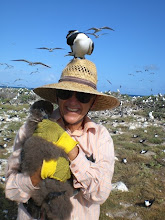
Last Thursday while helping the visitor group plant native grasses I had an interesting experience. To backtrack I should say that albatross regularly whoosh by close enough that you hear the sound of their passing. On this day I looked up and had a Laysan Albatross about 5 feet in front of my face coming at me at 30 miles an hour. I think I flinched and its wing hit me between my glasses and my hat and stunned me. I turned around and the bird had been upended and landed awkwardly, it shook it feathers into place and looked around like it was making sure no one was looking and walked away. Both of us were fine.

Snorkel Trip to the Outer Reef


Friday afternoon we were able to tag along when the visitor group went snorkeling. Our supervisor is good about giving us time off to participate when these opportunities arise so it was a good way to end the work week. The weather was calm and the water was very clear. I wear a 2mm wet suit and can stay in the water about an hour before I get chilled. The first two photos are Sailfin Tang, the third is a Spectacled Parrotfish about 2 feet long, and last is a Pencil Urchin. The Parrotfish eat coral and can be seen eating chunks of coral and defecating coral sand.
Saturday, April 24, 2010
Albatross Hazards


Albatross face many hazards one of which is damage to their feet. The following pictures are a collection of photos I've taken over the past month. I don't know if anyone knows how all this happens but fishing gear, I believe, would be a good guess.
Red-tailed Tropicbird


Red-tailed Tropicbirds are one of the sea birds that we monitor regularly. We have plots that are checked 2 times per week where we look for new nests and read the bands of any birds that we find on nests. When we find a nest we read the bird's band and put a spot of fingernail polish on its head. When we see the unmarked bird for the first time we read its band and after that we can use binoculars and look for the polish mark and know which bird we are seeing. Many of these adults are returning year after year to the same nest site. We also keep track of when the eggs are laid, when they hatch, and if the nest fails or the chick fledges. Using this information, hatching success, total reproductive success, and adult survival can be computed. The attached pictures are a collection of shots from in and out of our plots. These adults have a wingspread of about 3 feet. Notice the oleander in the background of the second picture. Unfortunately too many plants grow well here.
Monday, April 19, 2010
Turtle Researcher

I spent the afternoon with a turtle researcher that is doing an assessment of the number of turtles on Midway. Midway is not an important nesting area for Hawaiian Green Sea Turtles and the researcher I spent time with believes it won't be in the future either because the areas around Midway don't provide much of the feeding habitat that the turtles prefer. They tag turtles with " pit tags" that are much like the chips that are implanted in dogs and cats for identification. One of the turtles we saw this afternoon had been first tagged in 1977 and they guessed it was at least 25 years old at that time based on its size and maturity. It is now about 40 inches long and has an estimated weight of more than 300 pounds. An interesting afternoon.
Sunday, April 18, 2010
Albatross Chicks
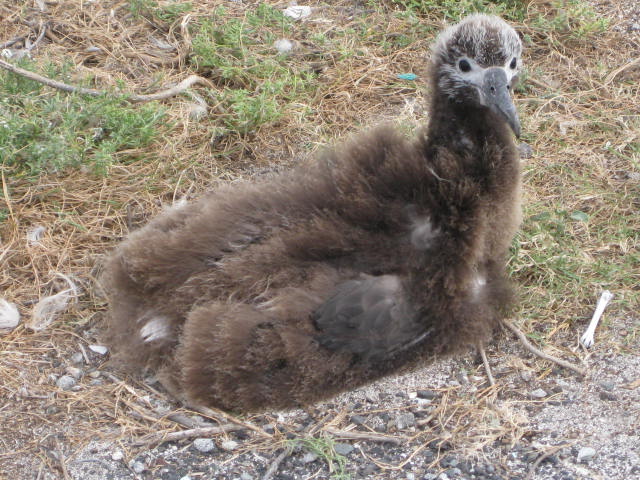


The albatross chicks are beginning to get permanent feathers to replace their down. They also have added size and weight since I last wrote about them. The following pictures show white feathers poking through on the Laysan chicks and dark feathers showing on the wing of the Black-footed chick. The top picture is a Black-footed chick and the next 2 are Laysan chicks.
Sunday, April 11, 2010
Passerine Birds on Midway


There are 2 passerine birds on Midway and both are introduced. Passerine birds are perching birds such as sparrows and robins. The Canary was introduced during the early days of the cable company. Today's population came from a release of a handful of caged birds that were brought out to the island as pets. The Common Myna is well established but I don't know how it came to Midway. The top picture is a Common Myna and the bottom 2 are Canary. The Myna is more wary so I don't have much of a picture.
Subscribe to:
Posts (Atom)